
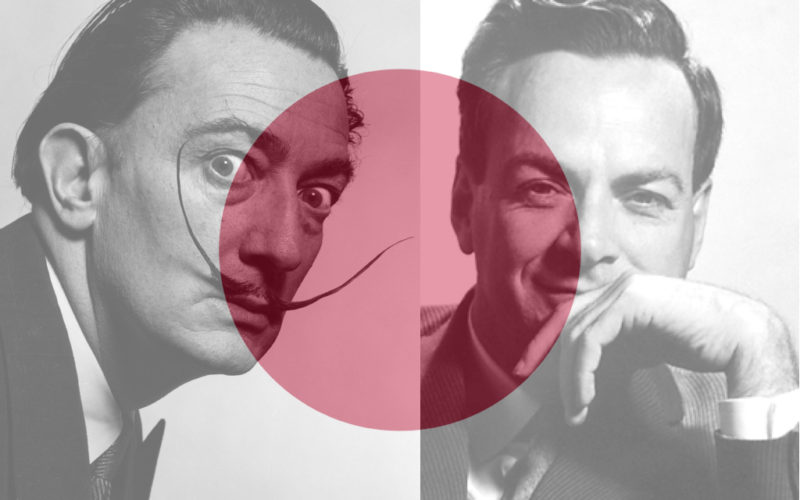
Today, we are celebrating Salvador Dali’s and Richard Feynman’s birthday, two remarkable human beings that influenced our perception of the world. They were both born on May 11th, Dali in 1904 and Feynman in 1918, though Dali lived much longer than Feynman.
Salvador Dali is one of the most interesting and talented artists of our times, while Richard Feynman was a brilliant mind in physics. I believe most people know Dali but perhaps not so many know Feynman. He may be most well-known to Americans for solving the Challenger disaster.
I have a lot of admiration for Feynman, which I discovered when I studied quantum mechanics at university. He won the Nobel prize jointly with Julian Schwinger and Shin’ichirō Tomonaga for their development of the theory of quantum electrodynamics (QED).
This theory describes how matter interacts with light, and was the first unification of quantum mechanics and special relativity. The unification of general relativity and quantum mechanics is still an unsolved problem in physics, and the finder(s) will probably win the Nobel Prize.
What else do Dali and Feynman have in common apart from being born on the same day?
Artist and scientist
They were both artists and scientists at the same time. Or at least they were interested in each other’s disciplines. Dali was very much interested in psychology, science and mathematics, while Feynman was interested in drawings and playing bongos.
Dali’s interest in science and mathematics was reflect in his work such as Galatea of the Spheres, Corpus Hypercubus and many others. For a more detailed read about Dali’s interest in science and mathematics I recommend this article.
Feynman is mostly known in physics for the Feynman Diagrams, little drawings that express very complex quantum field equations. This pictorial way of writing equations gave a more intuitive way to understand the interaction of sub-atomic particles. I don’t know if it was connected, but I wonder how much Feynman’s interest in art and drawing played a role in the invention of Feynman diagrams.

Dali, Feynman and Japan
Most people would say that Dali and Feynman were geniuses. I stopped believing in the concept of genius since I read the book Peak, Secrets from the New Science of Expertise by Anders Ericsson, who argues that what we call genius can be achieved by anyone who uses deliberate practice. I highly recommend this book.
In my opinion, one of the things that led Dali and Feynman to success in their work is their obsession with the details. We can call it Obsessive Attention to Details or OAD for short. If you look to Dali’s paintings, you can find fascinating details and you can see the care he took in every small detail. The same holds for Feynman. When you read his physics books, the details are explained with such clarity that he makes his books easy to understand despite the complicated ideas he is explaining.
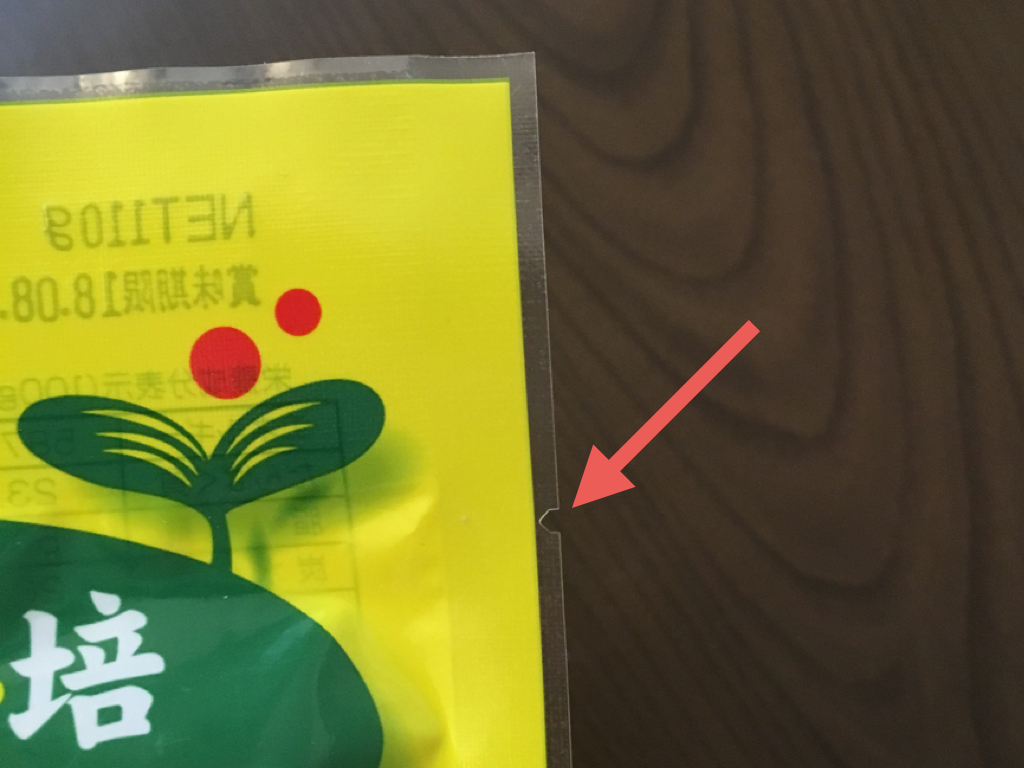
One of the things I appreciate about living and working in Japan is the OAD. As a tiny example, take this food package, which has a small dent to help you open it. Wherever I look in Japan, I find this small attention to detail. I am often moved by such care and consideration.
In my work as a scientist, often such attention to detail is what makes the difference between average work and excellent work. I think it’s true for all disciplines.
Lost in OAD!!
Obsession with detail is so present in most Japanese workplaces I have worked in and I love it. However, as with any other obsession it can sometimes cause feelings of frustration, and can make the work very slow.
One of my colleagues was describing an issue he was having with his project:
It’s as if there will be a birthday party in 3 months, and they got mad because I want to change the color of the party cups from green to light green.
The birthday party is a metaphor for his experiment that is within a large collaboration. This phrase really illustrates how OAD can be very challenging when working in Japan.
Other examples of an unnecessary level of OAD in the Japanese workplace:
- Meetings can take hours mostly because people focus more on details and lose perspective. This can make the project slow to complete.
- Another example is scientific paper writing. In most cases, after 6 months of writing and discussing with coauthors, a paper could be 70% ready, which is acceptable for submission to a scientific journal. However, in Japan people would spend another 6 months and sometimes up 2 years to improve it from 70% to 80-90% before submission. I am not sure it’s the most effective way because after submission to the journal, referees may or may not require further changes regardless. Also, in a year or two, the research may become irrelevant or international competition may publish similar results, which could prevent Japanese work from being published in high profile journals.
What is the missing ingredient?
One ingredient that I miss in the Japanese workplace is something I think Feynman and Dali mastered: Playfulness. The unnecessary level of OAD I described earlier makes life in the Japanese workplace too serious and therefore rigid.
I’m not advocating not to take things seriously. I would just suggest to make a distinction between taking things seriously and taking ourselves seriously. Allowing playfulness will liberate our thinking and creativity to allow us to solve problems differently.
My last word is: I hope we can just find the balance between OAD and Playfulness.
# You can subscribe to get blog posts directly in your inbox. I don’t sell ads on this website so you will receive the full article in your inbox and can read it without coming back here.
Great article. Thank you for linking to my blog about Dali!
Thank you for writing such an interesting article ^-^
Thank you for writing this insightful blog. I have always admired the two for the greatness within them. Little did I know that I share my date of birth with Dali and Feynman!
Intrigued and excited like a kid who discovered candy, I googled to search what other commonalities exist between the two. That is how I stumbled across your blog.
For someone who idolizes a very few people; only to discover someday that he shares his date of birth with the two of them, this piece of writing can never mean as much to someone as it does to me.
Thank you!
P.S. “Peak” just made it to the top of my ever-increasing reading list.