
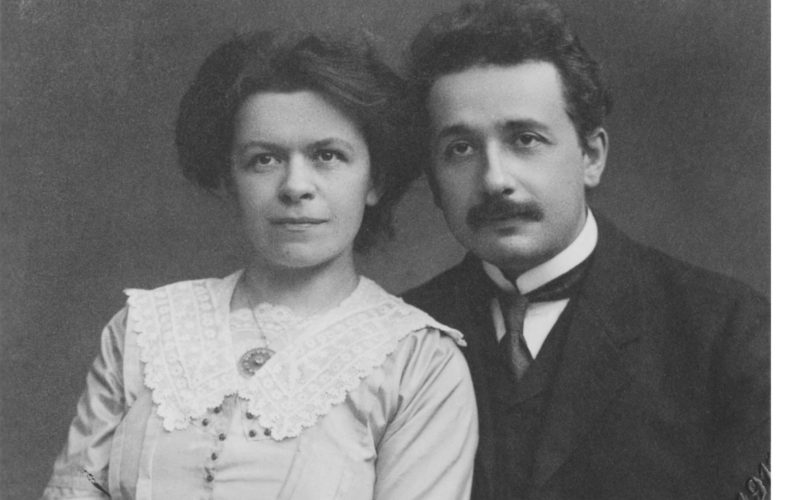
Mileva Marić was Einstein’s first wife. When she met Einstein at the Polytechnic Institute in Zurich, Switzerland, she had already overcome many obstacles faced by women in science of her time. Born into a wealthy Serbian family (ruled by Austro-Hungarian Monarchy at that time), her father obtained a special permission for Mileva Marić to enroll at the all-male Royal Classical High School in Zagreb. She later joined the Polytechnic Institute, which was one of the very few places in Europe admitting women to higher education, and then only under strict conditions. The records suggest that she would have to have been exceptionally good to get admitted at these institutions.
Mileva Marić joined the diploma course at the same time as Einstein. Her hope was to finish her diploma dissertation and continue on to a PhD thesis. Unfortunately, it didn’t happen for her!
She became pregnant by Einstein and had to abandon her dissertation to go back to Serbia and give birth. Some sources say the child didn’t survive, other sources suggest that the child was put up for adoption.
A year later, Mileva Marić married Einstein and her tragedy continued!
There are indications that she played an important role in Einstein’s major papers that lead him to win the Nobel Prize. However, there is no direct proof since she was never named or acknowledged in his papers.
As all women of her time, she was the one keeping their house and raising their kids. With time, their marriage became difficult. She might have been embittered because she had so much potential but she had to watch her husband rise while she got buried under housework and motherhood responsibilities.
In their divorce agreement in 1919, Einstein promised her the Nobel Prize money that he received 3 years later. She mainly invested it in buying buildings in Zurich to produce income to sustain her life and to support their two kids.
I thought that things had changed since that time but I was surprised during the interviews I conducted with several female scientists. The first hint was when I asked one of the top senior female scientists in my field how she had managed to attain this high position. She immediately said:
“You have to have support at home, otherwise it’s impossible to put in the hours necessary to achieve the results that bring recognition!”
I started then to explore this question; what is it that is different for women in their journey to success? Especially for the ones who have to care for their family.
Of course, things have improved since Mileva’s time, but not much has changed in the mentality toward women’s role within the family. One of the scientists I interviewed, who is also a mother, said:
“Mothers life has improved nowadays not because how men think but mainly because of technology and day care institutions, which make our burden less heavy.”
Unfortunately, women often still take the lead on the housework and childcare even when they have a full-time job.
So, let’s look at a case where a woman and a man start their careers at the same time. They later both have kids. The woman has to give birth and breastfeed, so she has to take few months off work. After coming back to work, on top of her job, she has to take care of the small child and do most of the housework. Five years later, maybe after having had another kid, the women would be likely to achieve less than the man because she is basically doing two jobs.
I propose the following questions:
- Is it fair in this situation to evaluate men and women in the same way when they both apply for tenure track or permanent positions?
- Even when women achieve as much as men and in some cases more, they are still facing discrimination because of their gender. Is this unfair toward these women who care for their families and want to advance in their careers?
I recently read this article published in Science Magazine. The author wrote about her joy and struggle as being a mother in science but noted that she had her first baby after getting a permanent position at age 38. Also, she doesn’t mention the role of her partner or/and family support nor of a day care system.
Of course, it is important to have such testimony from mothers in science but I find this overly romantic view is unhelpful for younger women. The average age women want to have kids nowadays is around their 30s or late 20s. However, most permanent positions in science are obtained about the mid or late 30s.
So how do we conciliate both having kids and attaining a permanent position for women before mid their 30s? This could be an important factor in keeping women in science.
Acknowledgement
I would like to thank Dr. Zeren Korkulu, Scientist, Mother and wife of a Scientist for the interesting discussions and her insights that inspired me to write this article.
# Subscribe to my newsletter and get the next full blogpost directly in your inbox!
Based on newly released letters (sealed by Einstein’s step-granddaughter, Margot Einstein, until 20 years after her death), Walter Isaacson reported that Maric eventually invested the Nobel Prize money in three apartment buildings in Zurich to produce income.
And Happy New Year!