
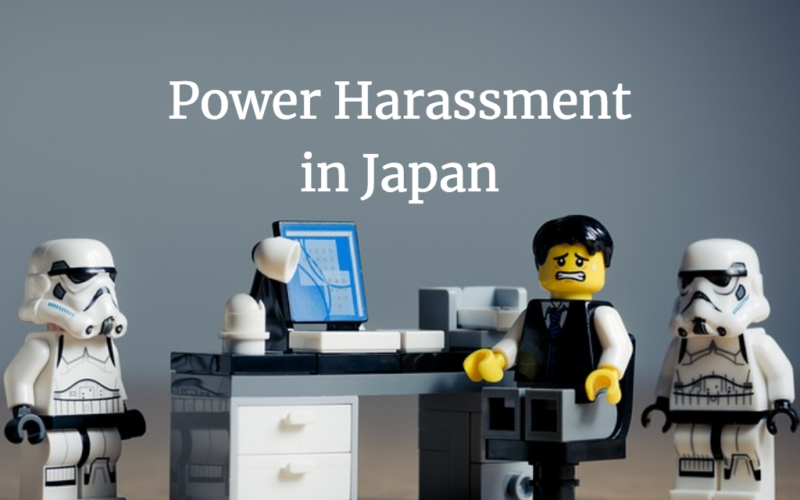
I had never heard the term “Power Harassment” before coming to Japan. I learned later that this word was actually invented in Japan and usually abbreviated as “Powaa-Hara” in Japanese. Power Harassment is the equivalent of “workplace bullying”. According to the Japanese Ministry of Health, Labor, and Welfare, Power Harassment is defined as:
Any kind of behaviour in which a superior takes advantage of his or her position in the workplace to cause co-workers physical pain or emotional distress, whether the person is superior by means of relative work position, physical size, or otherwise.
Since I have been in Japan, I have witnessed several situations of Power Harassment. Many friends and colleagues also experience Power Harassment every day at their workplace. There are actually many types of Power Harassment. I first thought it was limited to physical and emotional abuse but according to the Japanese Ministry of Health, Labor and Welfare, there are 6 types Power Harassment* :
#1 Physical Abuse
This is quite extreme type of power harassment but unfortunately not that uncommon. It includes hitting, grabbing, poking as well as throwing objects. You don’t have to be injured, anything the abuser does that makes you fear of your physical safety counts as physical abuse. If you experience or witness any acts of violence in your workplace by your colleagues or your boss, you are experiencing power harassment.
#2 Emotional Abuse
This is unfortunately a very common type of power harassment. It includes insults, threats, cruelty, scolding, publicly shaming and ridiculing. The abuse doesn’t have to be verbal, it can also be via e-mail or other types of written abuse. Emotional abuse can have damaging consequences on your mental health and often pushes workers into depression, which then lowers their performance and may lead to more abuse. Being stuck in this vicious circle can be really dangerous and in some extreme cases can lead to suicide. So, if you are experiencing this type of power harassment, know that you can do something about it to break the cycle.
#3 Isolation from Human Relationships
I think as foreigner we often experience isolation, which includes being left out, ignored and segregated. I personally experience this every day. When I started working in Japan, as with any other work environment, I went for lunch with my new colleagues. They knew I couldn’t speak Japanese, but they kept speaking only in Japanese and no one talked to me. I thought it was worse than eating alone. While I understand that English is not their preferred language and they were on their break, they were all capable English speakers. They chose their comfort over including a new team member and making me feel welcome. After a while, I stopped joining them for lunch.
Being ignored also includes ignoring your work. For example, you present your work in a meeting and no one asks any question or shows interest. Another example would be ignoring your questions. I have myself been in such a situation, and I sometimes wondered if I had died and it was just my ghost asking the question.
#4 Excessive Demands
This kind of power harassment is also common and can lead to huge stress. It includes being assigned clearly unnecessary or impossible assignments. Your boss might give you a large amount of work just before the end of the day. He/She might assign you a task that clearly cannot be done by one person. Or, gives you an extra job that interferes with your main or previously assigned work.
If your boss gives an amount of work that you cannot handle, even if you work very hard, or if your boss assigns work without providing the support you need or enough time to complete it, then you are experiencing power harassment.
#5 Demeaning Demands
This also we experience often as foreigners. As I explained in one of my previous articles: “5 Advantages of Being a Foreigner Working in Japan”, foreigners are not trusted especially at first. So, we are usually assigned work below our capabilities or just less work to do compared to our Japanese colleagues.
It can appear to be an advantage of being a foreigner in Japan, but actually is a form of power harassment. This also includes being assigned low-level work unrelated to job duties, experience, and abilities and being denied assignments.
So, if you keep getting assigned easy work that doesn’t match your capabilities, even if you ask for more, you are experiencing power harassment.
#6 Individual Intrusion
This last one is a bit astonishing to me and I have never experienced it or heard of it. In my experience, people are quite private at the workplace in Japan. My Japanese colleagues rarely ask me about my private life.
In any case, the Japanese Ministry of Health, Labor and Welfare defines this type of power harassment as excessive interference with the employees’ private lives. They give an example of a real case about a superior asking an employee private question such as: “where are you going on vacation and what is the name of accommodation?” when this employee asked their superior for annual paid leave. The superior refused to grant annual paid leave. In principle, you don’t have to give any reason when you ask your boss for annual paid leave. Also, your boss cannot ask you any private questions.
What can you do about it?
Usually employees experiencing power harassment suffer from more than one type of power harassment listed above. This can make your work life really difficult and very stressful and have damaging consequences in your private life.
The Japanese Ministry of Health, Labor and Welfare recognises these six types of power harassment. If you are experiencing any or several types you can legally do something about it. For more information see this link (only in Japanese*).
However, in any institution or company there must be some support for employees. If you are experiencing power harassment in your workplace, it is better to first consult with someone who can help you and resolve the situation internally.
In a future blogpost I will explore the reasons of such power harassment in Japan. Especially, I will focus on why such authoritarian and abusive behaviour is much more commonly tolerated in Japan.
* (Update April 4th, 2021) There is a new website for all types of harassment at work in Japanese with a multilingual section for harassment for foreign workers: https://www.no-harassment.mhlw.go.jp/.
Related articles:
5 Advantages of Being a Foreigner Working in Japan
Navigating Hierarchy in the Japanese Workplace
6 Tips that Will Make Starting Your Job in Japan Easier
i experience today where i’m working no need to say bakeru infront of other employees that’s why i decided to resign
It is very brave to resign, you should be proud of yourself for getting out of an abusive environment.
hello Sarah,
I found your article while searching for some advice on how to handle power harassments. i have been living and working in Japan for close to 13 years now and all the points you mentioned are so true and something which i face each and every day.
not sure if you have found a way around this but i was really glad to find someone who is going through this. i havent been able to find any forum where this is discussed or where someone like me can find some guidance. would it be ok if i share your article on my linkedin? it might be helpful to get some pointers from fellow foreign workers here.
wishing you luck,
manasi
Yes please share it.
It is very difficult to handle by yourself. I recommend talking to someone you trust within your workplace who can help you. Otherwise, it is important to get externel help.
I wish you all the best.